 Add to Chrome
 Add to Firefox
 Add to Edge
UnityMAS-O: A General RL Optimization Framework for LLM-Based Multi-Agent Systems
May 26, 2026
LLM-based multi-agent systems decompose complex tasks into interacting roles, but most remain manually orchestrated by prompts, tools, and control rules, while agents are rarely optimized through a unified reinforcement learning interface. Existing RL post-training frameworks mainly target single-policy optimization and lack abstractions for user-defined multi-agent workflows, structured interaction, role-specific credit assignment, and configurable parameter sharing. We present UnityMAS-O, a general RL optimization framework for LLM-based multi-agent systems. UnityMAS-O treats the complete workflow as the optimization unit, rather than a single response or policy trajectory. It represents workflows through four first-class objects: logical agent roles, graph trajectories, user-defined rewards, and agent--model mappings. This decouples logical agents from physical model parameters, supporting full sharing, full separation, and partial sharing, with rewards assigned at role, turn, and trajectory levels. UnityMAS-O extends verl with a Ray-based star-topology runtime. A central controller executes workflows, invokes tools, records structured trajectories, and assembles rewards; model-local worker groups handle rollout, buffering, advantage computation, and distributed PPO-style updates. Users can define agents, workflows, model mappings, and rewards without rewriting the optimization infrastructure. We instantiate UnityMAS-O on retrieval-augmented QA, iterative agentic search, and reflective code generation. Across Natural Questions, HotpotQA, and held-out code tasks, multi-agent RL improves manually specified workflows after optimization, with especially large gains for smaller models and strict code all-passed metrics. These results show that UnityMAS-O can serve as a reusable substrate for converting diverse LLM-based multi-agent workflows into trainable multi-agent RL systems.

PRAISE: Prefix-Based Rollout Reuse in Agentic Search Training
Apr 04, 2026In agentic search, large language models (LLMs) are trained to perform multi-turn retrieval and reasoning for complex tasks such as multi-hop question answering (QA). However, current search-based Reinforcement Learning (RL) methods suffer from two core limitations: expensive long-horizon rollouts are under-utilized during training, and supervision is typically available only at the final answer, resulting in severe reward sparsity. We present Prefix-based Rollout reuse for Agentic search with Intermediate Step rEwards (PRAISE), a framework for improving both data efficiency and credit assignment in agentic search training. Given a complete search trajectory, PRAISE extracts prefix states at different search turns, elicits intermediate answers from them, and uses these prefixes both to construct additional training trajectories and to derive step-level rewards from performance differences across prefixes. Our method uses a single shared model for both search policy learning and prefix answer evaluation, enabling joint optimization without extra human annotations or a separate reward model. Experiments on multi-hop QA benchmarks show that PRAISE consistently improves performance over strong baselines.
Addressing Personalized Bias for Unbiased Learning to Rank
Aug 28, 2025Unbiased learning to rank (ULTR), which aims to learn unbiased ranking models from biased user behavior logs, plays an important role in Web search. Previous research on ULTR has studied a variety of biases in users' clicks, such as position bias, presentation bias, and outlier bias. However, existing work often assumes that the behavior logs are collected from an ``average'' user, neglecting the differences between different users in their search and browsing behaviors. In this paper, we introduce personalized factors into the ULTR framework, which we term the user-aware ULTR problem. Through a formal causal analysis of this problem, we demonstrate that existing user-oblivious methods are biased when different users have different preferences over queries and personalized propensities of examining documents. To address such a personalized bias, we propose a novel user-aware inverse-propensity-score estimator for learning-to-rank objectives. Specifically, our approach models the distribution of user browsing behaviors for each query and aggregates user-weighted examination probabilities to determine propensities. We theoretically prove that the user-aware estimator is unbiased under some mild assumptions and shows lower variance compared to the straightforward way of calculating a user-dependent propensity for each impression. Finally, we empirically verify the effectiveness of our user-aware estimator by conducting extensive experiments on two semi-synthetic datasets and a real-world dataset.
Investigating the Robustness of Counterfactual Learning to Rank Models: A Reproducibility Study
Apr 04, 2024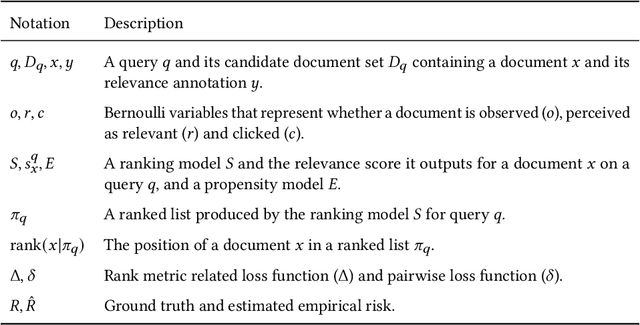
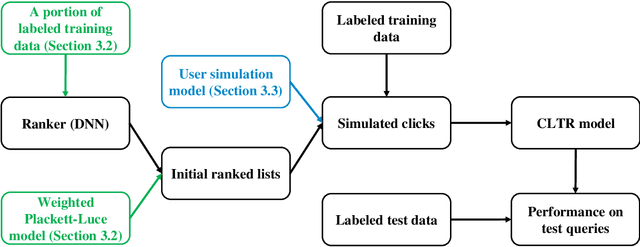
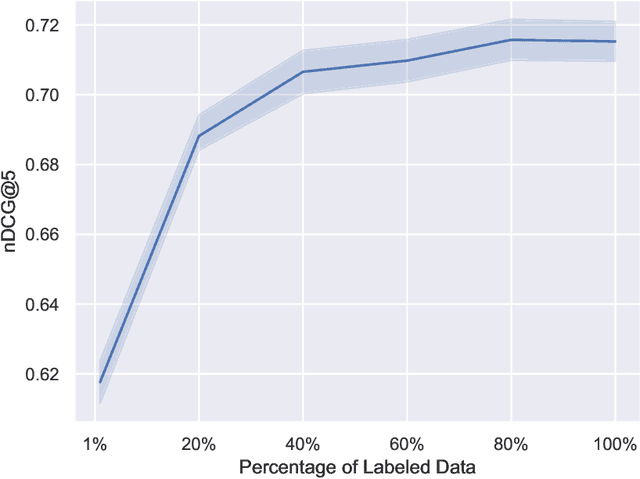
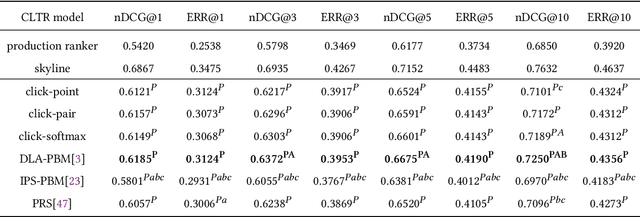
Counterfactual learning to rank (CLTR) has attracted extensive attention in the IR community for its ability to leverage massive logged user interaction data to train ranking models. While the CLTR models can be theoretically unbiased when the user behavior assumption is correct and the propensity estimation is accurate, their effectiveness is usually empirically evaluated via simulation-based experiments due to a lack of widely-available, large-scale, real click logs. However, the mainstream simulation-based experiments are somewhat limited as they often feature a single, deterministic production ranker and simplified user simulation models to generate the synthetic click logs. As a result, the robustness of CLTR models in complex and diverse situations is largely unknown and needs further investigation. To address this problem, in this paper, we aim to investigate the robustness of existing CLTR models in a reproducibility study with extensive simulation-based experiments that (1) use both deterministic and stochastic production rankers, each with different ranking performance, and (2) leverage multiple user simulation models with different user behavior assumptions. We find that the DLA models and IPS-DCM show better robustness under various simulation settings than IPS-PBM and PRS with offline propensity estimation. Besides, the existing CLTR models often fail to outperform the naive click baselines when the production ranker has relatively high ranking performance or certain randomness, which suggests an urgent need for developing new CLTR algorithms that work for these settings.